Site navigation
-
Spiders & other arachnids
- Spider diversity
- A Spider toolkit
- A spider's life
- Dangerous spiders
- Australia's spider fauna
- Bird-dropping spider, Celaenia excavata
- Black House Spider, Badumna insignis
- Carrai Cave Spider, Progradungula carraiensis
- Comb-footed Platform Spider, Achaearanea mundula
- Cupboard Spiders, Steatoda sp.
- Daddy-long-legs Spider, Pholcus phalangioides
- Flower Spiders, Diaea sp.
- Foliage Webbing Spider
- Fringed Jumping Spider, Portia fimbriata
- Ground spiders
- Huntsman Spiders
- Badge Huntsman Spiders, Neosparassus sp.
- Jumping spiders
- Lynx Spider
- Magnificent Spider
- Sydney Funnel-web Spider, Atrax robustus
- Net-casting Spiders
- Rufous Net-casting Spider
- Garden Orb Weaving Spiders
- Golden Orb Weaving Spiders, Nephila sp.
- Silver Orb Weaving Spiders
- Redback Spider, Latrodectus hasselti
- Red-headed Mouse Spider, Missulena occatoria
- Sac Spiders
- Slater-eating Spider
- Spotted Ground Spiders
- St Andrew's Cross Spider, Argiope keyserlingi
- Tasmanian Cave Spider
- Trapdoor Spiders
- Sydney Brown Trapdoor Spider, Misgolas villosus
- Triangular Spiders, Arkys sp.
- Tube spiders
- Two-spined Spider
- Whip Spider
- White-tailed Spider
- Wolf Spiders
- Garden Wolf Spider
- Spider facts
- Spiders in art and culture
- Spiders in the Australian Museum Collections
- Other Arachnids
-
Wildlife of Sydney
- Wildlife of Sydney
- Habitats of Sydney
- Crustaceans
- Lace corals and sea mats
- Jellyfish, anemones and corals
- Frogs
- Frogs: Class Amphibia
- Bleating Tree Frog
- Brown Toadlet
- Common Eastern Froglet
- Dainty Tree Frog
- Eastern Sedgefrog
- Eastern Pobblebonk Frog
- Giant Barred Frog
- Giant Burrowing Frog
- Green and Golden Bell Frog
- Green Tree Frog
- Haswell's Froglet
- Jervis Bay Tree Frog
- Leaf Green Tree Frog
- Lesueur's Frog
- Peron's Tree Frog
- Red-crowned Toadlet
- Red-eyed Tree Frog
- Rocket Frog
- Fletcher's Frog
- Striped Marsh Frog
- Spotted Marsh Frog
- Tusked Frog
- Tyler's Toadlet
- Verreaux's Tree Frog
- Insects
- Ant-raiding Ant
- Bull ants
- Funnel Ant
- Golden-spined Ant
- Green-head Ant
- Meat Ant
- Spider Ant
- Sugar Ant
- Common Blue-banded Bee
- Common Wasp-mimic Bee
- Cuckoo bees
- Feathery Leioproctus Bee
- Honey Bee
- Leafcutter Bee
- Masked bees
- Nomia bees
- Peacock Carpenter Bee
- Reed bees
- Stingless Bee
- White-banded bees
- Braconid wasps
- Cuckoo wasps
- Diapriid wasps
- European Wasp
- Fig wasps
- Flower wasps
- Hatchet wasps
- Ichneumonid wasps
- Mud-dauber Wasp
- Paper wasps
- Potter wasps
- Sand wasps
- Spider wasps
- Velvet ants
- Steel-blue sawflies
- Australian Carpet Beetle
- Beach rove beetles
- Bess Beetle
- Blue Mountains Firefly
- Bombardier Beetle
- Christmas Beetle
- Click beetles
- Darkling Beetle
- Feather-winged beetles
- Flat African Dung Beetle
- Jewel Beetle
- Lesser Grain Borer
- Long-nosed Lycid Beetle
- Orchid Beetle
- Paropsine Beetle
- Plague Soldier Beetle
- Powder Post Borer
- Pumpkin Beetle
- Punctate Flower Chafer Beetle
- Transverse Ladybird
- Three-punctured Diving Beetle
- Whirligig Beetle
- Bronze Orange Bug
- Cotton Harlequin Bug
- Crusader Bug
- Feather-legged Assassin Bug
- Floury Baker
- Giant Water Bug
- Greengrocer
- Green Vegetable Bug
- Termite Assassin Bug
- Australian Painted Lady
- Blue Triangle Butterfly
- Cabbage White Butterfly
- Caper White Butterfly
- Common Brown Butterfly
- Common Imperial Blue Butterfly
- Common Grass Blue
- Bronze Flat Butterfly
- Macleay's Swallowtail
- Meadow Argus Butterfly
- Orange Palm Dart
- Orchard Butterfly
- Wanderer Butterfly
- Yellow Admiral
- Emperor Gum Moth
- Giant Wood Moth
- Grapevine Moth
- Privet Hawk Moth
- Scribbly Gum Moth
- White-stemmed Gum Moth
- Fiery Skimmer
- Mountain Tigertail dragonfly
- Pygmy Shutwing
- South-eastern Petaltail
- Sydney Hawk Dragonfly
- Waterfall Redspot
- Balsam Beast
- Black Field Cricket
- Blackish Meadow Katydid
- Common Garden Katydid
- Common Macrotona Grasshopper
- Common Pyrgomorph
- Illawarra Raspy Cricket
- Mole Cricket
- Sydney Gum Leaf Katydid
- Flat Cockroach
- German Cockroach
- Native Cockroaches
- False Garden Mantid
- Purple-winged Mantid
- Australian Sheep Blowfly
- Biting midges
- Crane flies
- House Fly
- Hover flies
- March flies
- Mosquitoes
- Robber flies
- Vinegar Fly
- Reptiles
- Birds
- Birds: Aves
- Birds in Backyards: top 30 urban birds
- Australian Pelican
- Bar-tailed Godwit
- Black-faced Cuckoo-shrike
- Black Kite
- Common Bronzewing
- Common Koel
- Flame Robin
- Galah
- Golden Whistler
- Great Cormorant
- Great Egret
- House Sparrow
- Laughing Kookaburra
- Little Pied Cormorant
- Masked Lapwing
- Pallid Cuckoo
- Pied Oystercatcher
- Rainbow Lorikeet
- Sulphur-crested Cockatoo
- Tawny Frogmouth
- Yellow-tailed Black-Cockatoo
- Spiders
- What are spiders?
- Bird-dropping spider, Celaenia excavata
- Black House Spider, Badumna insignis
- Daddy-long-legs Spider, Pholcus phalangioides
- Flower Spiders, Diaea sp.
- Garden Orb Weaving Spiders
- Golden Orb Weaving Spiders, Nephila sp.
- Ground spiders
- Huntsman Spiders
- Jumping spiders
- Magnificent Spider
- Net-casting Spiders
- Redback Spider, Latrodectus hasselti
- Sac Spiders
- Silver Orb Weaving Spiders
- Spotted Ground Spiders
- Sydney Funnel-web Spider, Atrax robustus
- Trapdoor Spiders
- Wolf Spiders
- Centipedes and millipedes
- Sea squirts and cunjevoi
- Sea stars, sea urchins and other echinoderms
- Mammals
- Mammals: Mammalia
- Australian Fur Seal
- Black Rat
- Bottlenose Dolphin
- Bush Rat
- Common Bent-wing Bat
- Common Brushtail Possum
- Common Ringtail Possum
- Feathertail Glider
- Grey-headed Flying-fox
- House Mouse
- Humpback Whale
- Koala
- Long-nosed Bandicoot
- Short-beaked Echidna
- Southern Brown Bandicoot
- Southern Right Whale
- Spotted-tailed Quoll
- Sugar Glider
- Swamp Wallaby
- Water-rat
- Freshwater fish
- Sharks and rays
- Common Stingaree, Trygonoptera testacea Müller & Henle, 1841
- Eastern Shovelnose Ray, Aptychotrema rostrata (Shaw & Nodder, 1794)
- Greynurse Shark, Carcharias taurus Rafinesque, 1810
- Port Jackson Shark, Heterodontus portusjacksoni (Meyer, 1793)
- Spotted Wobbegong, Orectolobus maculatus (Bonnaterre, 1788)
- White Shark, Carcharodon carcharias (Linnaeus, 1758)
- Marine fishes
- Australian Mado, Atypichthys strigatus (Günther, 1860)
- Bigbelly Seahorse, Hippocampus abdominalis Lesson, 1827
- Blacktip Bullseye at South Solitary Island
- Eastern Blue Devil, Paraplesiops bleekeri
- Eastern Blue Groper, Achoerodus viridis (Steindachner, 1866)
- Eastern Frogfish, Batrachomoeus dubius (White, 1790)
- Eastern Wirrah, Acanthistius ocellatus (Günther, 1859)
- Fanbelly Leatherjacket, Monacanthus chinensis (Isbeck, 1765)
- Fortescue, Centropogon australis (White, 1790)
- John Dory, Zeus faber Linnaeus, 1758
- Luderick, Girella tricuspidata (Quoy & Gaimard, 1824)
- Mulloway, Argyrosomus japonicus (Temminck & Schlegel, 1844)
- Old Wife, Enoplosus armatus (White, 1790)
- Peppered Sole, Aseraggodes sp
- Pineapplefish, Cleidopus gloriamaris De Vis, 1882
- Red Indianfish, Pataecus fronto Richardson, 1844
- Red Morwong, Cheilodactylus fuscus (Castelnau, 1879)
- Eastern Red Scorpionfish, Scorpaena jacksoniensis Steindachner 1866
- Sand Whiting, Sillago ciliata Cuvier, 1829
- Sergeant Baker, Hime purpurissatus Richardson, 1843
- Common Silverbiddy, Gerres subfasciatus (Cuvier, 1830)
- Snapper, Pagrus auratus
- Sydney Cardinalfish, Apogon limenus (Randall & Hoese, 1988)
- Trumpetfish, Aulostomus chinensis (Linnaeus, 1766)
- Weedy Seadragon, Phyllopteryx taeniolatus (Lacépède, 1804)
- White's Seahorse, Hippocampus whitei Bleeker, 1855
- Molluscs
- Overview of molluscs - Phylum Mollusca
- Non-marine Molluscs
- Blacklip Abalone
- Black Nerites
- Blue-lined Octopus
- Blue mussels
- Cart-rut Shell
- Common Pipi
- Common Sydney Octopus
- Elephant Snail
- Garden Snail
- Giant Cuttlefish
- Ischnochiton australis
- Leopard Slug
- Limpets
- Little Blue Periwinkle
- Red Triangle Slug
- Sea Hare
- Squid
- Sydney Cockle
- Sydney Mud Whelk
- Sydney Rock Whelk
- Turban Snail
- Violet Snail
- Zebra Snail
- Sponges
- About the Museum
- What's on
- Visiting the Australian Museum
ANIMAL SPECIES:Wolf Spiders
Wolf Spiders are found throughout Australia. They are robust, agile hunters that live on the ground in leaf litter or burrows. They are often found in lawns and gardens.
Identification
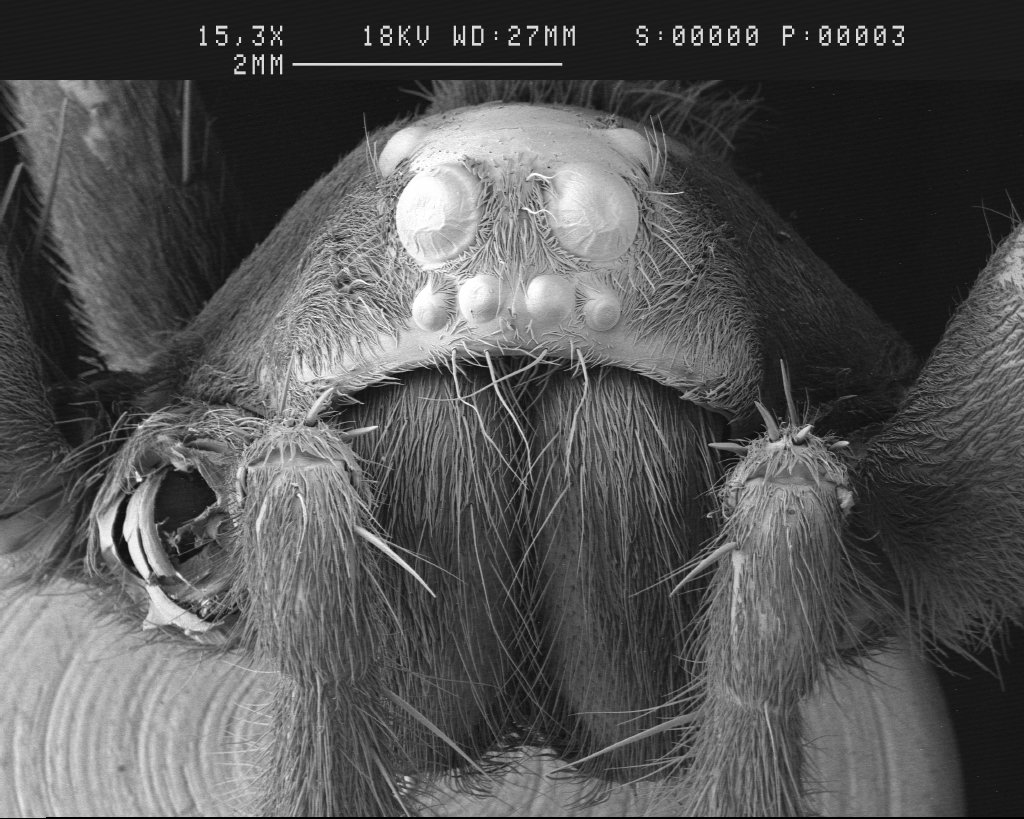
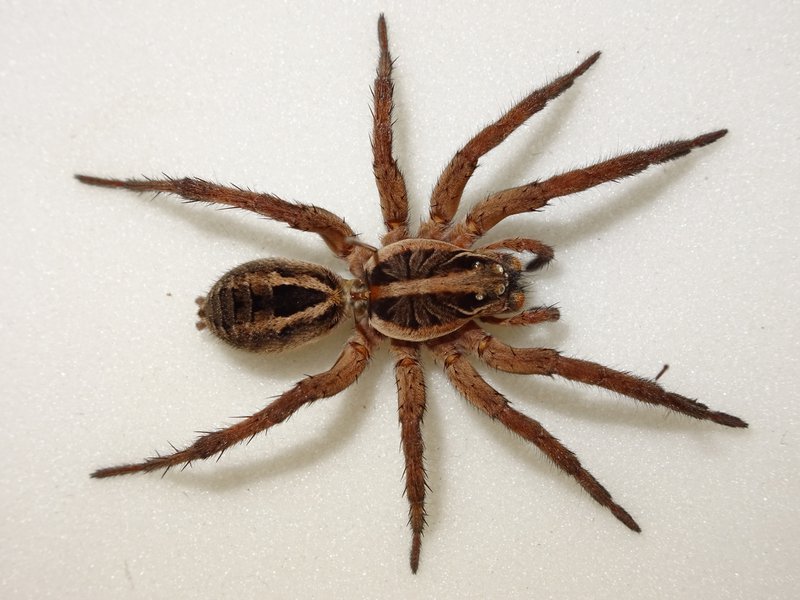
There are many species of Wolf Spider, ranging in size. Their body colours are typically drab, with most having variegated patterns in brown and yellow, grey, black and white; some inland species are a bright salmon pink below. Often the patterns include radiating lines on the carapace (front of the body) and scroll-like patterns on the abdomen. The spider's underside is light grey, cream or black, sometimes salmon pink, often with black or white markings superimposed. The sides of their jaws may have a small raised orange spot or 'boss'. Wolf spiders have eight eyes in three rows (4,2,2), with the four smaller eyes in front and the four largest arranged in a square on top of the high and convex head. Two of the commonest Australian species are Lycosa godeffroyi and L. leuckartii, with a wide range in the temperate parts of the continent.
Size range
1 cm - 8 cmDistribution
Many Wolf Spiders have wide distributions, especially across inland regions. This distribution is aided by their ability to disperse aerially as spiderlings or small juveniles over large distances. Many also have very specific microhabitat preferences such as stream-side gravel beds, montane herb-fields or coastal sand-dunes.
Habitat
Wolf Spiders are found in habitats ranging from dry inland shrublands and woodlands to wet coastal forests and alpine meadows. Some species, such as Lycosa furcillata and L. godefffroyi are common in suburban gardens.
Behaviour and adaptations
Feeding and Diet
According to the Queensland Museum, two Wolf spider species are known to be predators of cane toads. Lycosa lapidosa will take small toads and frogs while L. obscuroides has been noted biting and killing a large toad within one hour.
Other behaviours and adaptations
Most Wolf Spiders are wanderers but some build burrows, either open or with a trapdoor, while others may make temporary retreats in vegetation. Arid zone species build turrets to deflect floodwaters during rainy periods, while others use pebbles to plug their burrows. In woodlands, twigs may be used to form a palisade around the top of the burrow. Burrows of the Grey Wolf Spider (Lycosa simsoni) have a circular trap door that is often left open when the spider is out hunting.The shape and materials used to form burrows and trapdoors may help to distinguish similar-looking species.
Life cycle
The female constructs an egg sac of white papery silk, shaped like a ball with an obvious circular seam, which she then carries around attached with strong silk to her spinnerets. When the spiderlings hatch, they are carried around on the female's back until they are ready to disperse by ballooning or on the ground. Such a high degree of parental care is relatively unusual among spiders.
Wolf Spiders live for up to two years.
Mating and reproduction
Mating takes place outside the female's burrow at night. Some adult male Wolf Spiders of smaller-sized species are known to disperse by air in order to find mates. The male is attracted by scent markings left by the female, often associated with her drag-line silk. Males perform a courtship ritual prior to mating, often involving complex leg and palp signalling to the female.
Living with us
Danger to humans and first aid
Symptoms of a Wolf spider bite are usually minor, restricted to local pain or itchiness. Less commonly, symptoms can include swelling, prolonged pain, dizziness, rapid pulse and nausea.
Seek medical attention if symptoms persist.
Classification
- Family:
- Lycosidae
- Superfamily:
- Lycosoidea
- Order:
- Araneae
- Class:
- Arachnida
- Phylum:
- Arthropoda
- Kingdom:
- Animalia
References
- Simon-Brunet, B. 1994 The Silken Web Reed Books, Chatswood.
- York Main, B. 1976 Spiders William Collins Publishers Pty Ltd, Sydney.
Last Updated: 24 June 2010
Would you like to add a comment?
Sign up to add comments and find out more about the other benefits you can enjoy.
Would you like to add a tag?
Sign up to add tags and find out more about the other benefits you can enjoy.
Related items
Female Wolf spider with young and egg sac View full size
John Fields
© Australian Museum
Eye shine from a Wolf Spider View full size
Jim Frazer
© Jim Frazer
Wolf spider burrow with lid closed View full size
Mike Gray
© Australian Musuem
Wolf spider burrow with lid open View full size
Mike Gray
© Australian Musuem
Featured product

Spiderwatch: a Guide to Australian Spiders
Bert Brunet - Published by Reed New Holland 1998, (Paperback)
Price: $29.95
Support us
Your support will have a real impact.
Online Shop
Great gifts.
Australian Museum Members
Join today.
Australian Museum Business Services
Professional consulting.
Museum as a Venue
Unique spaces.
Media Resources
Contact Publicity.
news
Isabelle Kingsley
02 February 2012
Ancient cultures, from Greece to Asia, have used urine as a fertiliser to provide nutrients to their crops. Is recycling our urine a radical solution to global food security and saving our waterways?
Patricia Egan
02 February 2012
Archives volunteer, Ada Klinkhamer writes of her experience rehousing and documenting photographs and illustrations prepared for use in publications by Australian Museum ornithologist, Alfred John North.
what's new
what's popular
- Australian Museum Ichthyology Collection
- Australian Lungfish
- Australian Museum Mammalogy Collection
- Australian Museum Ornithology Collection
- Warty Prowfish, Aetapcus maculatus (Günther, 1861)
- Australian Museum Palaeontology Collection
- Palorchestes: A tale of misidentification
- Birds: Aves
- Mammals: Mammalia
- Sawflies, Wasps, Bees and Ants: Order Hymenoptera
recent comments
Blotched Blue-tongue Lizard
Hi Jo,
Reptiles are generally solitary creatures, and inevitably when two animals are placed in an enclosure...
Leaf and Stick Insects: Order Phasmatodea
Hi Doc Pete,
In the AM's Search & Discover section, we keep up to 5 species including Spiny Leaf...
Peron's Tree Frog
These frogs are also in South Australia we go to the River Murray quite often (Morgan) & they are everywhere...


3 comments
bobbyc1
1.05 PM, 24 May 2011
heres the pic
Comment Attachment
bobbyc1
12.05 PM, 24 May 2011
I found this spider on the outside wall of our house in Victoria. Is it a Wolf Spider ?
Report misuse