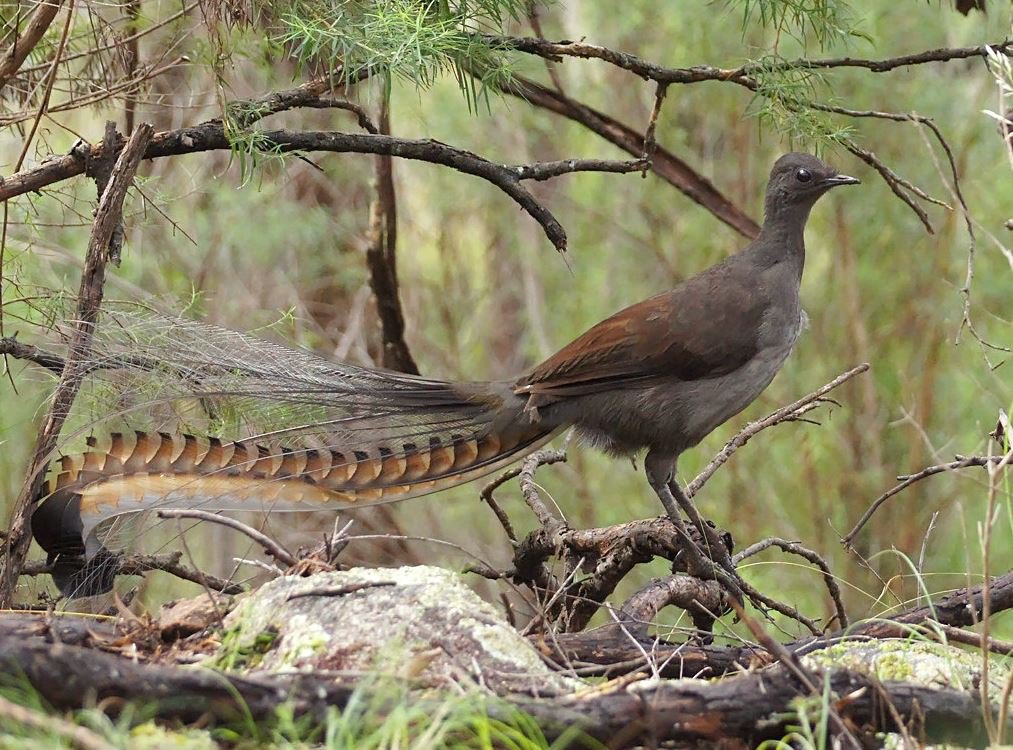
Superb Lyrebird
Albert's Lyrebird
 Click to enlarge image
creative commons
Fast Facts
-
Classification
- Genus
- Menura
- Species
- novaehollandiae
- Family
- Menuridae
- Order
- Passeriformes
- Class
- Aves
- Phylum
- Chordata
- Kingdom
- Animalia
-
- Size Range
- 80 - 100 cm in long (including tail)
The Superb Lyrebird looks like a large brown pheasant.
What do Superb Lyrebirds look like?
Identification
The Superb Lyrebird looks like a large brown pheasant. The wings are rufous in colour and the bill, legs and feet are black. The adult male has an ornate tail, with special curved feathers that, in display, assume the shape of a lyre. The tails of females and young males are long, but lack the specialised feathers.

https://creativecommons.org/licenses/by-nc/4.0/
Where do Superb Lyrebirds live?
Habitat
Moist forests. It is a ground-dwelling species in moist forests, but roosts in trees at night. Birds are sedentary, rarely moving large distances and generally staying in a home-range about 10 km in diameter.
Distribution
South-eastern Australian mainland and southern Tasmania.
What do Superb Lyrebirds eat and how do they communicate?
Feeding and diet
Superb Lyrebirds feed on insects, spiders, worms and, occasionally, seeds. It finds food by scratching with its feet through the leaf-litter. Birds tend to forage alone, but females and young males may be seen feeding together.
Communication
Natural and mechanical sounds imitated.
The Superb Lyrebird's song is somewhat famous. About 80% of the song consists of expert mimicry, with both and joined together in a rousing medley. Sounds can include anything heard in the bird's immediate surroundings, such as chainsaws, car engines, dog barks and local native birds. The Superb Lyrebird also emits a series of whistles and cackling notes that are used as territorial calls, as well as a loud alarm shriek.

https://creativecommons.org/licenses/by-nc/4.0/
How do Superb Lyrebirds breed?
Breeding behaviours
Superb Lyrebirds breed in April to October each year (the season is slightly shorter in the north of its range). The male secures a territory, attracting potential mates by singing and dancing on one of several mounds within it, while throwing the tail forward over the body and shaking it in display. The male will mate with several females. The female alone builds the nest, incubates the eggs and cares for the young.
Breeding Season: April to October (slightly shorter in north of range).
References
- Higgins, P.J., Peter, J.M. and Steele, W.K. (eds) 2001. Handbook of Australian, New Zealand and Antarctic Birds, Volume 5 (Tyrant-flycatchers to Chats). Oxford University Press, Melbourne.
- Strahan, R. (ed) 1994. Cuckoos, Nightbirds and Kingfishers of Australia. Angus and Robertson/Australian Photographic Index of Australian Wildlife, Sydney.
The Birds of Australia online publication
Delve into The Birds of Australia online publication and discover the incredible world of Australian birdlife. Trace the journey of ornithologist John Gould and his wife Elizabeth on one of the most significant birding expeditions in history and learn about the unique and diverse bird species in Australia.
Explore now