Site navigation
-
Spiders & other arachnids
- Spider diversity
- A Spider toolkit
- A spider's life
- Dangerous spiders
- Australia's spider fauna
- Bird-dropping spider, Celaenia excavata
- Black House Spider, Badumna insignis
- Carrai Cave Spider, Progradungula carraiensis
- Comb-footed Platform Spider, Achaearanea mundula
- Cupboard Spiders, Steatoda sp.
- Daddy-long-legs Spider, Pholcus phalangioides
- Flower Spiders, Diaea sp.
- Foliage Webbing Spider
- Fringed Jumping Spider, Portia fimbriata
- Ground spiders
- Huntsman Spiders
- Badge Huntsman Spiders, Neosparassus sp.
- Jumping spiders
- Lynx Spider
- Magnificent Spider
- Sydney Funnel-web Spider, Atrax robustus
- Net-casting Spiders
- Rufous Net-casting Spider
- Garden Orb Weaving Spiders
- Golden Orb Weaving Spiders, Nephila sp.
- Silver Orb Weaving Spiders
- Redback Spider, Latrodectus hasselti
- Red-headed Mouse Spider, Missulena occatoria
- Sac Spiders
- Slater-eating Spider
- Spotted Ground Spiders
- St Andrew's Cross Spider, Argiope keyserlingi
- Tasmanian Cave Spider
- Trapdoor Spiders
- Sydney Brown Trapdoor Spider, Misgolas villosus
- Triangular Spiders, Arkys sp.
- Tube spiders
- Two-spined Spider
- Whip Spider
- White-tailed Spider
- Wolf Spiders
- Garden Wolf Spider
- Spider facts
- Spiders in art and culture
- Spiders in the Australian Museum Collections
- Other Arachnids
-
Wildlife of Sydney
- Wildlife of Sydney
- Habitats of Sydney
- Crustaceans
- Lace corals and sea mats
- Jellyfish, anemones and corals
- Frogs
- Frogs: Class Amphibia
- Bleating Tree Frog
- Brown Toadlet
- Common Eastern Froglet
- Dainty Tree Frog
- Eastern Sedgefrog
- Eastern Pobblebonk Frog
- Giant Barred Frog
- Giant Burrowing Frog
- Green and Golden Bell Frog
- Green Tree Frog
- Haswell's Froglet
- Jervis Bay Tree Frog
- Leaf Green Tree Frog
- Lesueur's Frog
- Peron's Tree Frog
- Red-crowned Toadlet
- Red-eyed Tree Frog
- Rocket Frog
- Fletcher's Frog
- Striped Marsh Frog
- Spotted Marsh Frog
- Tusked Frog
- Tyler's Toadlet
- Verreaux's Tree Frog
- Insects
- Ant-raiding Ant
- Bull ants
- Funnel Ant
- Golden-spined Ant
- Green-head Ant
- Meat Ant
- Spider Ant
- Sugar Ant
- Common Blue-banded Bee
- Common Wasp-mimic Bee
- Cuckoo bees
- Feathery Leioproctus Bee
- Honey Bee
- Leafcutter Bee
- Masked bees
- Nomia bees
- Peacock Carpenter Bee
- Reed bees
- Stingless Bee
- White-banded bees
- Braconid wasps
- Cuckoo wasps
- Diapriid wasps
- European Wasp
- Fig wasps
- Flower wasps
- Hatchet wasps
- Ichneumonid wasps
- Mud-dauber Wasp
- Paper wasps
- Potter wasps
- Sand wasps
- Spider wasps
- Velvet ants
- Steel-blue sawflies
- Australian Carpet Beetle
- Beach rove beetles
- Bess Beetle
- Blue Mountains Firefly
- Bombardier Beetle
- Christmas Beetle
- Click beetles
- Darkling Beetle
- Feather-winged beetles
- Flat African Dung Beetle
- Jewel Beetle
- Lesser Grain Borer
- Long-nosed Lycid Beetle
- Orchid Beetle
- Paropsine Beetle
- Plague Soldier Beetle
- Powder Post Borer
- Pumpkin Beetle
- Punctate Flower Chafer Beetle
- Transverse Ladybird
- Three-punctured Diving Beetle
- Whirligig Beetle
- Bronze Orange Bug
- Cotton Harlequin Bug
- Crusader Bug
- Feather-legged Assassin Bug
- Floury Baker
- Giant Water Bug
- Greengrocer
- Green Vegetable Bug
- Termite Assassin Bug
- Australian Painted Lady
- Blue Triangle Butterfly
- Cabbage White Butterfly
- Caper White Butterfly
- Common Brown Butterfly
- Common Imperial Blue Butterfly
- Common Grass Blue
- Bronze Flat Butterfly
- Macleay's Swallowtail
- Meadow Argus Butterfly
- Orange Palm Dart
- Orchard Butterfly
- Wanderer Butterfly
- Yellow Admiral
- Emperor Gum Moth
- Giant Wood Moth
- Grapevine Moth
- Privet Hawk Moth
- Scribbly Gum Moth
- White-stemmed Gum Moth
- Fiery Skimmer
- Mountain Tigertail dragonfly
- Pygmy Shutwing
- South-eastern Petaltail
- Sydney Hawk Dragonfly
- Waterfall Redspot
- Balsam Beast
- Black Field Cricket
- Blackish Meadow Katydid
- Common Garden Katydid
- Common Macrotona Grasshopper
- Common Pyrgomorph
- Illawarra Raspy Cricket
- Mole Cricket
- Sydney Gum Leaf Katydid
- Flat Cockroach
- German Cockroach
- Native Cockroaches
- False Garden Mantid
- Purple-winged Mantid
- Australian Sheep Blowfly
- Biting midges
- Crane flies
- House Fly
- Hover flies
- March flies
- Mosquitoes
- Robber flies
- Vinegar Fly
- Reptiles
- Birds
- Birds: Aves
- Birds in Backyards: top 30 urban birds
- Australian Pelican
- Bar-tailed Godwit
- Black-faced Cuckoo-shrike
- Black Kite
- Common Bronzewing
- Common Koel
- Flame Robin
- Galah
- Golden Whistler
- Great Cormorant
- Great Egret
- House Sparrow
- Laughing Kookaburra
- Little Pied Cormorant
- Masked Lapwing
- Pallid Cuckoo
- Pied Oystercatcher
- Rainbow Lorikeet
- Sulphur-crested Cockatoo
- Tawny Frogmouth
- Yellow-tailed Black-Cockatoo
- Spiders
- What are spiders?
- Bird-dropping spider, Celaenia excavata
- Black House Spider, Badumna insignis
- Daddy-long-legs Spider, Pholcus phalangioides
- Flower Spiders, Diaea sp.
- Garden Orb Weaving Spiders
- Golden Orb Weaving Spiders, Nephila sp.
- Ground spiders
- Huntsman Spiders
- Jumping spiders
- Magnificent Spider
- Net-casting Spiders
- Redback Spider, Latrodectus hasselti
- Sac Spiders
- Silver Orb Weaving Spiders
- Spotted Ground Spiders
- Sydney Funnel-web Spider, Atrax robustus
- Trapdoor Spiders
- Wolf Spiders
- Centipedes and millipedes
- Sea squirts and cunjevoi
- Sea stars, sea urchins and other echinoderms
- Mammals
- Mammals: Mammalia
- Australian Fur Seal
- Black Rat
- Bottlenose Dolphin
- Bush Rat
- Common Bent-wing Bat
- Common Brushtail Possum
- Common Ringtail Possum
- Feathertail Glider
- Grey-headed Flying-fox
- House Mouse
- Humpback Whale
- Koala
- Long-nosed Bandicoot
- Short-beaked Echidna
- Southern Brown Bandicoot
- Southern Right Whale
- Spotted-tailed Quoll
- Sugar Glider
- Swamp Wallaby
- Water-rat
- Freshwater fish
- Sharks and rays
- Common Stingaree, Trygonoptera testacea Müller & Henle, 1841
- Eastern Shovelnose Ray, Aptychotrema rostrata (Shaw & Nodder, 1794)
- Greynurse Shark, Carcharias taurus Rafinesque, 1810
- Port Jackson Shark, Heterodontus portusjacksoni (Meyer, 1793)
- Spotted Wobbegong, Orectolobus maculatus (Bonnaterre, 1788)
- White Shark, Carcharodon carcharias (Linnaeus, 1758)
- Marine fishes
- Australian Mado, Atypichthys strigatus (Günther, 1860)
- Bigbelly Seahorse, Hippocampus abdominalis Lesson, 1827
- Blacktip Bullseye at South Solitary Island
- Eastern Blue Devil, Paraplesiops bleekeri
- Eastern Blue Groper, Achoerodus viridis (Steindachner, 1866)
- Eastern Frogfish, Batrachomoeus dubius (White, 1790)
- Eastern Wirrah, Acanthistius ocellatus (Günther, 1859)
- Fanbelly Leatherjacket, Monacanthus chinensis (Isbeck, 1765)
- Fortescue, Centropogon australis (White, 1790)
- John Dory, Zeus faber Linnaeus, 1758
- Luderick, Girella tricuspidata (Quoy & Gaimard, 1824)
- Mulloway, Argyrosomus japonicus (Temminck & Schlegel, 1844)
- Old Wife, Enoplosus armatus (White, 1790)
- Peppered Sole, Aseraggodes sp
- Pineapplefish, Cleidopus gloriamaris De Vis, 1882
- Red Indianfish, Pataecus fronto Richardson, 1844
- Red Morwong, Cheilodactylus fuscus (Castelnau, 1879)
- Eastern Red Scorpionfish, Scorpaena jacksoniensis Steindachner 1866
- Sand Whiting, Sillago ciliata Cuvier, 1829
- Sergeant Baker, Hime purpurissatus Richardson, 1843
- Common Silverbiddy, Gerres subfasciatus (Cuvier, 1830)
- Snapper, Pagrus auratus
- Sydney Cardinalfish, Apogon limenus (Randall & Hoese, 1988)
- Trumpetfish, Aulostomus chinensis (Linnaeus, 1766)
- Weedy Seadragon, Phyllopteryx taeniolatus (Lacépède, 1804)
- White's Seahorse, Hippocampus whitei Bleeker, 1855
- Molluscs
- Overview of molluscs - Phylum Mollusca
- Non-marine Molluscs
- Blacklip Abalone
- Black Nerites
- Blue-lined Octopus
- Blue mussels
- Cart-rut Shell
- Common Pipi
- Common Sydney Octopus
- Elephant Snail
- Garden Snail
- Giant Cuttlefish
- Ischnochiton australis
- Leopard Slug
- Limpets
- Little Blue Periwinkle
- Red Triangle Slug
- Sea Hare
- Squid
- Sydney Cockle
- Sydney Mud Whelk
- Sydney Rock Whelk
- Turban Snail
- Violet Snail
- Zebra Snail
- Sponges
- About the Museum
- What's on
- Visiting the Australian Museum
ANIMAL SPECIES:Huntsman Spiders
Australian Huntsman spiders belong to the Family Sparassidae (formerly Heteropodidae) and are famed as being the hairy so-called 'tarantulas' on house walls that terrify people by scuttling out from behind curtains.
Alternative Name/s
Tarantula, Giant Crab SpiderNumber of species
94 described species.Identification
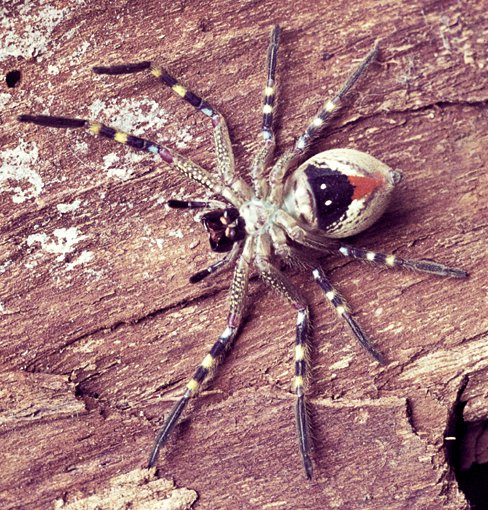
Huntsman spiders are large, long-legged spiders.. They are mostly grey to brown, sometimes with banded legs. Many huntsman spiders, especially Delena (the flattest), and including Isopeda, Isopedella and Holconia, have rather flattened bodies adapted for living in narrow spaces under loose bark or rock crevices. This is aided by their legs which, instead of bending vertically in relation to the body, have the joints twisted so that they spread out forwards and laterally in crab-like fashion ('giant crab spiders'). Both Brown (Heteropoda) and Badge (Neosparassus) Huntsman spiders have less flattened bodies.
Brown Huntsman (Heteropoda species) spiders are patterned in motley brown, white and black.
Size range
Body lengths: 2 cm (female), 1.6 cm (male); Leg span: up to 15 cmDistribution
These genera are generally widely distributed throughout Australia, although Heteropoda is absent from most of Southeastern Australia and Tasmania has only a few Huntsman species, notably Delena cancerides and Neosparassus spp.
Habitat
Huntsman Spiders are found living under loose bark on trees, in crevices on rock walls and in logs, under rocks and slabs of bark on the ground, and on foliage. Dozens of the social huntsman species, Delena cancerides, can be seen sitting together under bark on dead trees and stumps (notably wattles) but they can also be found on the ground under rocks and bark slabs.
Huntsman spiders of many species sometimes enter houses. They are also notorious for entering cars, and being found hiding behind sun visors or running across the dashboard.
Behaviour and adaptations
Feeding and Diet
Food consists of insects and other invertebrates.
Life cycle
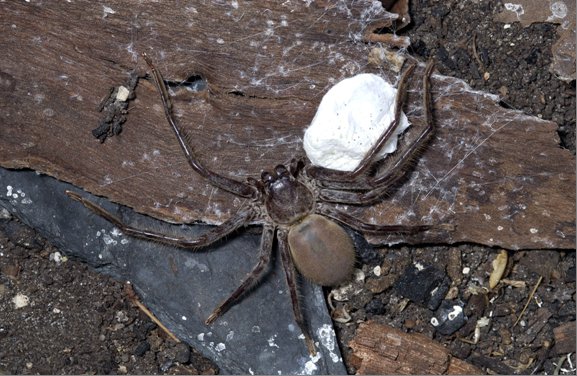
The female Huntsman (Isopeda, for example) produces a flat, oval egg sac of white papery silk, and lays up to 200 eggs. She then places it under bark or a rock, and stands guard over it, without eating, for about three weeks. During this period the female can be quite aggressive and will rear up in a defensive display if provoked. Some species will even carry their egg sac under their bodies while moving about. Delena females lay a ground-sheet of silk upon which the egg sac is anchored while the eggs are laid into it. They will then complete her egg sac and pick it up, leaving the silk ground-sheet behind. Incubation periods vary and are probably influenced by climatic conditions.
In some cases (Isopeda), the female may moisten and tear the egg sac open, helping her spiderlings to emerge. The mother stays with them for several weeks. Young Huntsman spiders are pale. They undergo several moults while still with their mother, hardening to a darker brown, and eventually disperse.
Huntsman spiders, like all spiders, moult in order to grow and often their old skin may be mistaken for the original spider when seen suspended on bark or in the house.
The lifespan of most Huntsman species is about two years or more.
Mating and reproduction
In the genus Isopoda, the male and female Huntsman spiders have a lengthy courtship, which involves mutual caresses, with the male drumming his palps on the trunk of a tree. He then inserts his palps into the female to fertilise her eggs. The male is rarely attacked, unlike some other species, and in fact many huntsman spiders live peacefully together in large colonies. A silken retreat is often built for egg laying, as well as for moulting.
Predators, Parasites and Diseases
Predators of Huntsman Spiders include birds and geckoes, Spider Wasps, nematode worms and egg parasites (wasps and flies).
Living with us
Danger to humans and first aid
A cold pack may relieve local pain. Seek medical attention if symptoms. persist.
Classification
- Family:
- Sparassidae
- Superfamily:
- Sparassoidea
- Order:
- Araneae
- Class:
- Arachnida
- Phylum:
- Arthropoda
- Kingdom:
- Animalia
References
- McKeown, K.C. 1952. Australian Spiders: their lives and habits. Angus and Robertson.
- York Main, B. 1976. Spiders. William Collins Publishers Pty Ltd, Sydney NSW.
Last Updated: 13 October 2011
Would you like to add a comment?
Sign up to add comments and find out more about the other benefits you can enjoy.
Would you like to add a tag?
Sign up to add tags and find out more about the other benefits you can enjoy.
Huntsman spider View full size
M Gray
© Australian Museum
Brown Huntsman Spider View full size
S Humphreys
© Australian Museum
Badge Huntsman Spider, showing underside View full size
R Mascord
© Australian Museum
Badge Huntsman Spider on twig View full size
B Hulbert
© B Hulbert
Green Huntsman Spider View full size
Stuart Humphreys
© Australian Museum
Huntsman Spider with egg sac View full size
S Humphreys
© Australian Museum
Common Huntsman Spider eggs View full size
Pavel German
© Pavel German
Huntsman spider and its worm parasite View full size
Carl Bento
© Australian Museum
Featured product

Spiderwatch: a Guide to Australian Spiders
Bert Brunet - Published by Reed New Holland 1998, (Paperback)
Price: $29.95
Support us
Your support will have a real impact.
Online Shop
Great gifts.
Australian Museum Members
Join today.
Australian Museum Business Services
Professional consulting.
Museum as a Venue
Unique spaces.
Media Resources
Contact Publicity.
news
Isabelle Kingsley
02 February 2012
Ancient cultures, from Greece to Asia, have used urine as a fertiliser to provide nutrients to their crops. Is recycling our urine a radical solution to global food security and saving our waterways?
Patricia Egan
02 February 2012
Archives volunteer, Ada Klinkhamer writes of her experience rehousing and documenting photographs and illustrations prepared for use in publications by Australian Museum ornithologist, Alfred John North.
what's new
what's popular
- Australian Museum Ichthyology Collection
- Australian Lungfish
- Australian Museum Mammalogy Collection
- Australian Museum Ornithology Collection
- Warty Prowfish, Aetapcus maculatus (Günther, 1861)
- Australian Museum Palaeontology Collection
- Palorchestes: A tale of misidentification
- Birds: Aves
- Mammals: Mammalia
- Sawflies, Wasps, Bees and Ants: Order Hymenoptera
recent comments
Blotched Blue-tongue Lizard
Hi Jo,
Reptiles are generally solitary creatures, and inevitably when two animals are placed in an enclosure...
Leaf and Stick Insects: Order Phasmatodea
Hi Doc Pete,
In the AM's Search & Discover section, we keep up to 5 species including Spiny Leaf...
Peron's Tree Frog
These frogs are also in South Australia we go to the River Murray quite often (Morgan) & they are everywhere...


5 comments
Louise Carter
8.10 AM, 13 October 2011
@Rollers123 - I’m not aware of any comprehensive studies of the DNA of Huntsman Spiders (Sparassidae). This family has a worldwide distribution with endemic species in many countries: http://research.amnh.org/iz/spiders/catalog/SPARASSIDAE.html . It is likely that only a handful of species have had their ranges extended due to human agency, primarily due to modern transportation.
Rollers123
10.09 PM, 15 September 2011
Has there been any DNA studies of these spiders on a worldwide basis? The results could be very interesting inasmuch as to special geographical origins. the global spread of these spiders is quite extensive (we know NZ got their lot from us in a shipment of sleepers in the 20s) and the knowledge may help us understand more about land movement and human migration patterns.
heavonleigh
11.03 PM, 08 March 2011
2nd photo showing other side of spider. Sorry about the flash, but the little bugger was quick
Comment Attachment
heavonleigh
11.03 PM, 08 March 2011
Pretty sure one of these bit me the other night, Unfortunately it was in my jeans on the front lower part of my leg and I squashed it beyond easy recognition. Now have a large angry rash on my leg (veru itchy). Is it likely that this spider would cause such a rash? Sorry - I have to add another comment after this to show both views of the spider
Comment Attachment
Enivea
8.11 AM, 08 November 2010
I had this spider on my window last night, and just after I took this image, the spider leaped to catch the moth that was fluttering about. Poor spider, the moth escaped and the spider fell to the ground. It was all over in an instant!
Comment Attachment
Report misuse