Site navigation
-
Insects
- Insects
- Insects that bite and sting
- Australian insects
- Ants: Family Formicidae
- Bees: Suborder Apocrita
- Beetles: Order Coleoptera
- Cicadas: Superfamily Cicadoidea
- Cockroaches: Order Blattodea
- Dragonflies and damselflies: Order Odonata
- Flies and mosquitoes: Order Diptera
- Grasshoppers, crickets, katydids and locusts: Order Orthoptera
- Lacewings and Antlions: Order Neuroptera
- Leaf and Stick Insects: Order Phasmatodea
- Moths, butterflies and skippers: Order Lepidoptera
- Praying mantises: Order Mantodea
- Sawflies, Wasps, Bees and Ants: Order Hymenoptera
- Wasps: Suborder Apocrita
- What are the differences between butterflies and moths?
- What are the differences between bugs and beetles?
- What are the differences between ants and termites?
- What are the differences between flies and wasps?
- Insects in the house and garden
- Insects in the Australian Museum Collections
-
Invertebrate Collections
- Insects
- Spiders and their Relatives
- Molluscs
- All other invertebrates
-
Rapid Digitisation Project
- The Project
- Atlas of Living Australia
- Resources
- Virtual Volunteering
- The Collections
- Blog Posts
- Our Volunteers
- About the Museum
- What's on
- Visiting the Australian Museum
Australian Museum Entomology Collection
Entomology is the study of insects. Insects include animals such as flies, cicadas, moths, earwigs, fleas, bugs, cockroaches, bees, dragonflies, and termites.
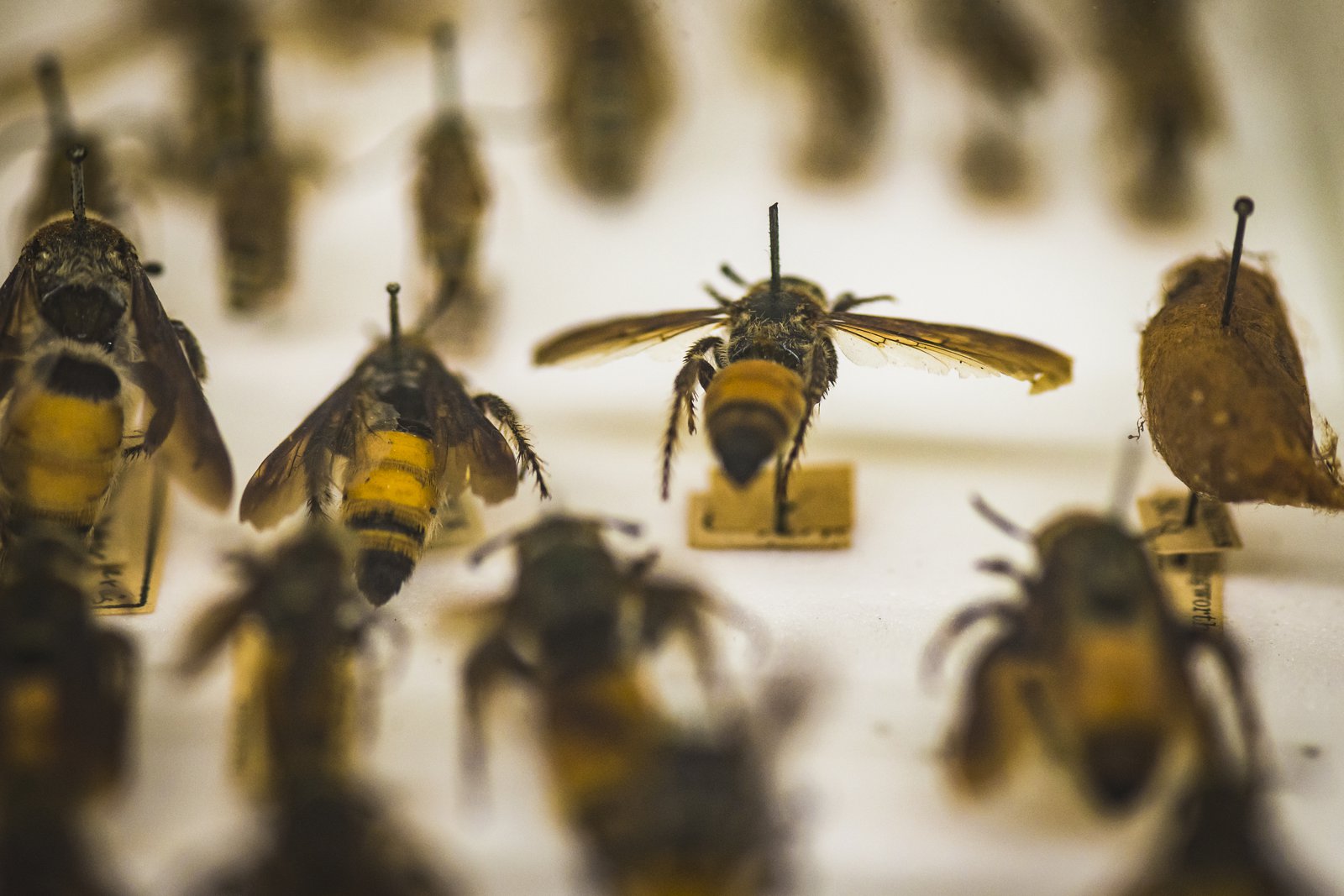
Insects are animals that have:
- a pair of antennae
- six walking legs
- a body divided into three parts
- a skeleton outside the body
- mouthparts which are adapted for particular diets
About the collection
The Australian Museum entomology collection contains mostly Australian species but there is a strong non-Australian representation of beetles, psocids (booklice), flies, butterflies and moths. The collection also has many undescribed species and species found in no other collections. The Australian Museum has the world's largest collections of bark lice and Australian acalyptrate flies and major collections of antlions, alderflies and beetles.
It is estimated that Australia has over 300,000 insect species, but only 160,000 have been named or described. Australian Museum entomologists spend much of their research time studying, describing and naming the many undescribed species contained in the vast collection.
Dr
Dave Britton
, Collection Manager, Entomology
Last Updated: 19 September 2011
Would you like to add a comment?
Sign up to add comments and find out more about the other benefits you can enjoy.
Would you like to add a tag?
Sign up to add tags and find out more about the other benefits you can enjoy.
Entomology Collection View full size
Tiki Rand
© Australian Museum
Support us
Your support will have a real impact.
Online Shop
Great gifts.
Australian Museum Members
Join today.
Australian Museum Business Services
Professional consulting.
Museum as a Venue
Unique spaces.
Media Resources
Contact Publicity.
news
Isabelle Kingsley
02 February 2012
Ancient cultures, from Greece to Asia, have used urine as a fertiliser to provide nutrients to their crops. Is recycling our urine a radical solution to global food security and saving our waterways?
Patricia Egan
02 February 2012
Archives volunteer, Ada Klinkhamer writes of her experience rehousing and documenting photographs and illustrations prepared for use in publications by Australian Museum ornithologist, Alfred John North.
what's new
- This week in Fish: Shark beaching and Cobbler Wobbegong
- Calling on Tongan Traditions: Decline in Natural Resources
- Calling on Tongan Traditions: Handicrafts
- Blacktip Reef Shark at Casuarina Beach
- Spangled Emperor from near the Solitary Islands
- X-Ray Vision: Fish Inside Out
- Calling on Tongan Traditions: Ngatu
- The Power of X-rays
- The Miss Muriel Snell Collection
- Wobbegong Sharks
what's popular
- Australian Museum Ichthyology Collection
- Australian Lungfish
- Australian Museum Mammalogy Collection
- Australian Museum Ornithology Collection
- Warty Prowfish, Aetapcus maculatus (Günther, 1861)
- Australian Museum Palaeontology Collection
- Palorchestes: A tale of misidentification
- Birds: Aves
- Mammals: Mammalia
- Sawflies, Wasps, Bees and Ants: Order Hymenoptera
recent comments
Greyface Moray, Gymnothorax thyrsoideus
Hi rling. You are right! Thank you for pointing this out. The spelling of thyrsoideus has been corrected...
Greyface Moray, Gymnothorax thyrsoideus
Apparently a common misspelling of "Gymnothorax thyrsoideus".
http://marinespecies.org/aphia.php?p=taxdetails&id=399889
I...
Wanderer Butterfly
The attached picture is of the larval stage of Danaus plexippus, in my garden, in Denmark, Western Australia....


56 comments
Dave Britton
11.09 AM, 06 September 2011
Hi Andrew,
In regards the image of Choerocoris paganus it is just variation between individual specimens in this case.
In regards to appropriate webpage, rather than posting enquiries on this page which is more a general page about the Entomology collection, post them on the pages that deal with particular Orders, eg. for bugs, post on the Hemiptera page, grasshoppers on the Orthoptera page, ants on the ant page, and so on. That way others who go looking for identifications can use previous enquiries to help out.
thanks,
Dave.
andrewhodgson
5.09 AM, 03 September 2011
Update for the bug above, Dave - have searched the Brisbane Insects site, and the Black Hill beetle looks like Choerocoris paganus but lacks the red stripe behind the head. Just regional variation of that species?
andrewhodgson
5.09 AM, 03 September 2011
Thanks very much for helping with the grasshopper Dave. Rest assured I've tried to look at all sorts of places on the internet for IDs - with some success too. I don't many photos to ID either, so don't worry - I appreciate you've all quite rightly got far more important things to do with your time! When you said submit things to the relevant web[age, which did you mean? Look forward to hearing from you, and thank you very much again for your help. I've attached an Adelaide Hills beetle which I have not been able to make progress with, even at genus level.
Comment Attachment
Dave Britton
2.09 PM, 02 September 2011
Hi Andrew,
I'm willing to identify a limited number of insect photos (or at least try), but only if you can show you've had a go yourself first, and if you post the enquiries under the relevant webpage. Unfortunately time constraints make it difficult to do more than this. BTW, the grasshopper is a nymph of the bark-mimicking grasshopper Coryphistes ruricola, a very widespread and common Australian grasshopper.
andrewhodgson
8.09 AM, 02 September 2011
Hi Dave Just discovered this site today. I lived in the Adelaide Hills a couple of years ago, but am now back in the UK. I'm putting all sorts of photos on my website (www.andydownunder.com) but am having trouble identifying some of the insects I saw. Any help you can give would be great. many thanks. I have attached one of the grasshoppers here.
Comment Attachment
Olga
7.06 PM, 29 June 2011
Thanks Dave and thankyou to Graham. It will be interesting to see the adult specimen!
Dave Britton
3.06 PM, 28 June 2011
Hi Olga,
Graham Milledge has identified this as a juvenile of Austrovates variegata. I hope this helps.
Olga
9.06 PM, 26 June 2011
another photo
Comment Attachment
Olga
9.06 PM, 26 June 2011
Hi Dave, Im currently doing my honours year with the Behavioural Ecology Research Group at Macquarie University, studying genital chirality in Ciulfina. Since i started, ive had quite a few friends ask for help with identification of mantids they have encountered. Unfortunately i am not familiar with the specimen shown here. Originally i thought it was an Archimantis latistyla but the lobes on the legs, the shape of the head and the pattern on the eyes would indicate otherwise. Could you help me out here? Thanks so much!
Comment Attachment
pixie
5.05 AM, 28 May 2011
Thanks for your help Dave. The kids and I have been enjoying learning from you.
Dave Britton
1.05 PM, 27 May 2011
Hi,
That one is actually an adult antlion (family Myrmeleontidae) rather than an owlfly (family Ascalaphidae). The eye looks like it has been damaged - they are normally spherical.
pixie
7.05 AM, 27 May 2011
Hi Dave, Thank you. for your reply. I also have a question about an owlfly- do their eyes normally look like this?
Comment Attachment
Dave Britton
1.05 PM, 26 May 2011
Hi Bianca,
It is the nymph of an assassin bug (Hemiptera: Reduviidae).
pixie
7.05 AM, 26 May 2011
Hi, I was wondering if you could tell me what type of insect this is that seems to be eating an ant?
Comment Attachment
Dave Britton
8.05 AM, 02 May 2011
Hi Chrissy,
It is the larva of a tussock moth in the genus Calliteara (Family Lymantriidae). They are common in wetter coastal forests, especially rainforest, but also in wet sclerophyll.
cheers,
Dave.
chrissy
1.05 PM, 01 May 2011
This looks like the place to ask about identifying strange insects! I hope I can get some help with this caterpillar. We saw it in cool temperate rainforest in New England National Park climbing a mossy Antarctic Beech tree. It was quite spectacular with long white hairs, yellow head and bottom, and four more solid, feather-like extensions on its back amongst the white hairs. It was about 5-6 cm long. Would love to know what it is and what it will become! Thanks for any help.
Comment Attachment
Dave Britton
12.05 PM, 01 May 2011
Hi Sammy,
I can't see a link to your photo. Can you either retry attaching the image to a comment, or leave a link for me.
Sammy Costanzo
1.04 PM, 30 April 2011
I had trouble loading the photo, with my first comment, bettle on photo book you can look at, have set security for Museum to see.
Sammy Costanzo
1.04 PM, 30 April 2011
Hi, I have found a beetle in my garden and think it may be a jewel bug but can't find it in any of our books or on the net. thought someone here might be able to help me identify it. I found it in our vegie patch near the corn and I shifted it onto a Camellia to take a better photo. The top looks like a jewel bettle and the underneath shows a bright polka dot red and white/yellow lower section, like colourful boxer shorts. Do you think you may know what this is?
sjd
8.03 PM, 08 March 2011
thanks a lot Dave, really appreciate it, finally know what it is! Was hoping it was a new species, but unfortunately no, but thanks anyway, guess I'll have to keep looking :D Keep up the great work :D
Dave Britton
7.03 PM, 08 March 2011
You caught me when I was reviewing other comments! They are reasonably common where their hosts are present (usually blue-banded bees in the genus Amegilla). Nearly all bee species have stings, but in Australia only the highly social introduced honey bee is aggressive, so stings from native bees are very rare. You would have to have one trapped in clothing, or try to hold it in your hand.
flipperish
6.03 PM, 08 March 2011
thanks for such a quick reply, Dave. Are they common? I live in Ku-ring-gai but as I said, haven't seen them before. I did notice a sting appear as I was trying to take the photo :-)
Dave Britton
6.03 PM, 08 March 2011
Hi Sebastien,
This is the bronze orange bug, a well-known pest of citrus including cumquats. australianmuseum.net.au/Bronze-Orange-Bug
Dave Britton
6.03 PM, 08 March 2011
Hi Phillipa,
It is a cuckoo bee in the genus Thyreus (Family Apidae). Bees are really specialised wasps, so wasp is pretty much the correct answer!
flipperish
6.03 PM, 08 March 2011
I have never seen this wasp/fly before, it was in my house today. About the size and shape of a german wasp, but a little slimmer, it was matt black with regular white? spots on its body and legs. Sorry the image is so fuzzy, it was in a perspex chamber being expelled!
Comment Attachment
sjd
11.03 AM, 08 March 2011
and here's another photo, with it's wing up on the left,, not clearly visible though, sorry for the tilt of the photo as well. Thanks :D
Comment Attachment
sjd
11.03 AM, 08 March 2011
Hi, these insects have sometimes been lurking on a kumquat tree in the garden, I haven't been able to identify them, on the internet or in books, and was wondering if you could help me. Thanks a lot, love this museum, and insects :D
Comment Attachment
Dave Britton
8.02 AM, 23 February 2011
Hi Chris,
The fly is in the genus Steganopis in the family Lauxaniidae. I can't say much about the identity of the mite as small red mites are frequently found on a wide range of different insects. Many of these mites are probably phoretic, meaning they are using the insect as a means of transport from one place to another, but others are parasitic and are feeding on body fluids from the host insect.
Dave Britton
8.02 PM, 22 February 2011
Dear Steve, that is the gardenia bee hawk moth Cephonodes kingii (Family Sphingidae). The brightly coloured larvae feed predominately on ornamental gardenias, particularly those varities with larger leaves. It is a common species in Sydney, especially since gardenias are now very popular with landscapers. www.boic.org.au/01_cms/details.asp has an article by Martyn Robinson on this species.
ChrisRoss
9.02 PM, 17 February 2011
Hi Dave, trying again. Chris
Comment Attachment
Nails01
9.02 PM, 16 February 2011
Hi, I observed this moth like insect feeding on the flowering Plumbago in Warrawee Sydney. I have never seen this type of moth before. Can you please identify this species. Regards Steve
Comment Attachment
Dave Britton
9.02 AM, 16 February 2011
Hi Chris,
The image file does not seem to have attached correctly to your comment. Can you please post again?
ChrisRoss
11.02 AM, 12 February 2011
Hi Dave, wondering if you could chance an identification of this fly (and perhaps even the mite), found nectaring on Baeckea virgata flowers at home, size is tiny about the size of Drosera sp. maybe 3-4mm long. I measured one of the petals from those flowers at 2mm across. This was at home, south of the Royal NP Sydney.
Comment Attachment
Dave Britton
9.01 AM, 27 January 2011
Hi Aline,
For those species which are timber pests, or are suspected of being timber pests there is the book by Hadlington "Termites and other common timber pests" published by NSW Uni Press. This is very easy to use, and is usually my first choice when tackling pest identifications. There is also the CSIRO "Atlas of Australian Termites" by Watson and Abbey www.publish.csiro.au/pid/15.htm. Good luck with your reading!
alinepoh
8.01 PM, 23 January 2011
Hi, I'm really fascinated with termites and have been collecting them and preserving them using ethanol. Is there any place or good reference book or reference collection that I could go to so that I can identify the termite species that I am collecting?
Dave Britton
10.12 PM, 03 December 2010
Dear Rebecca,
There is no one right way of preserving all insects, as some soft-bodied insects are better preserved in liquid preservatives and others as dry specimens. Without knowing what you want to preserve it is not possible to recommend one particular method. For example, adult insects in the order Lepidoptera (moths and butterflies) should nearly always be preserved as dry specimens, but the immature stages (caterpillars) are better preserved in liquid preservatives.
marino
1.12 PM, 01 December 2010
Hi, I'm collecting and preserving insects as a hobby. I'm using "Methods for collecting, preserving and studying insects" as a practical guide but was wondering what is the best solution to preserve the insects I've stored in a freezer? Cheers
Dave Britton
2.10 PM, 14 October 2010
Dear Gilly,
These are not insects, but are crustaceans in the group known as Amphipoda. These terrestrial examples are sometimes called "sand fleas". The Australian Museum Marine Invertebrates collection handles these animals if you want to enquire further.
Gilly
6.10 PM, 07 October 2010
Oh, and I forgot to mention that they always appear in the morning and they're always dead... I'm yet to see one alive despite getting up at odd hours :)
Gilly
6.10 PM, 07 October 2010
Hello, Just wondering if anyone can help me? Every couple of weeks I find a little cluster of these insects on my living room floor and I have no idea what they are or where they are coming from. If anyone could identify it and tell me a little about it I would be grateful :) Cheers, Gill
Comment Attachment
Dave Britton
12.09 PM, 17 September 2010
Dear Beverley,
Apart from the images online that you can find by using the search box at the top of the web page there are currently no other images of jewel beetles online that are on pages hosted by the Museum. This may change when our collections database goes online (hopefully soon). The museum also had an online Lucid key for identification of NSW christmas beetles (genus Anoplognathus), but this is currently not available. There are plans to have it up and running again soon. This key had images of all of the species found in NSW.
bevcoleclough
1.09 AM, 13 September 2010
How do i check out your collection of images of jewel beetles and Christmas beetles online?
Dave Britton
9.07 PM, 12 July 2010
Hi Sophia,
This is a water bug in the family Belostomatidae (Order Hemiptera). They are sometimes called "toe biters" in Australia. These aquatic bugs are fierce predators of other invertebrates and small vertebrates such as fish and tadpoles, and are capable of delivering a very painful bite with their sucking mouthparts if molested by humans. Like many aquatic insects they are very capable at flying, and are strongly attracted to artificial light sources at night.
Sophia Cason
1.07 PM, 12 July 2010
Hello I live in Timor-Leste, and on the weekend in the mountains, was surprised by this large insect. Does anyone know what it is called? (it appeared at night and presumably flew towards the light)
Comment Attachment
Dave Britton
3.04 PM, 14 April 2010
kate.skinner2
8.03 PM, 17 March 2010
last one :)
Comment Attachment
kate.skinner2
8.03 PM, 17 March 2010
heres another pic
Comment Attachment
kate.skinner2
8.03 PM, 17 March 2010
Hi, Can anyone please tell me what these are??? They have been at our place for years and finally I got a semi decent photo of them to allow me to ask for your help. Thanks, kate : )
Comment Attachment
Dave Britton
9.12 AM, 01 December 2009
Dear Tamar and other interested people - I have added a page which details the life history of an owlfly (Ascalaphidae).
http://australianmuseum.net.au/Life-history-of-an-Owlfly/
tamar
3.11 PM, 25 November 2009
thanks dave,im pretty sure what i saw resembled lacewing on wire picture.though its antennae was was the same legnth as its body and i olny saw it in flight. this is a great sight for people who are curious but dont know too much. id never even heard of a lacewing just assumed it was some sort of dragonfly.very beautiful insect could be out of a magical childrens book!! the owlfly....love it!!!! anyway i hope i get to see one again. thanks so much dave.i know where to come if i have any other questions.ive asked two questions and both have been replyed to with speed.awsome!!! tamar
Dave Britton
10.11 AM, 25 November 2009
Dear Tamar,
The insect you saw is almost certainly an owlfly, which is actually a type of lacewing in the family Ascalphidae in the Order Neuroptera. Stay tuned for an Australian Museum web page that provides details on this group of insects. Here is our current page on the Neuroptera:
http://australianmuseum.net.au/Lacewings-and-Antlions-Order-Neuroptera/
tamar
1.11 AM, 24 November 2009
saw a dragonfly last night it had thin long antennae with little round ends,ive never seen one before,my sister hadnt either. it was hovering near the light out front but by the time id gotten the camera it had gone.does anyone know what sort this is?.i dont know much about insects but i know when i see something different from the usual.thanks guys.
Ondine Evans
11.07 AM, 01 July 2009
Xyris, we would love it if you could repost your question on the Bull Ants page: http://www.australianmuseum.net.au/Bull-ants/ This way, we can start a thread of discussion about identifying bull ants and other topics directly related to that particular page. Great photo by the way!
xyris
3.06 PM, 27 June 2009
Hello, Is this the place to ask for confirmation that this is Myrmecia piliventris
Comment Attachment
Report misuse